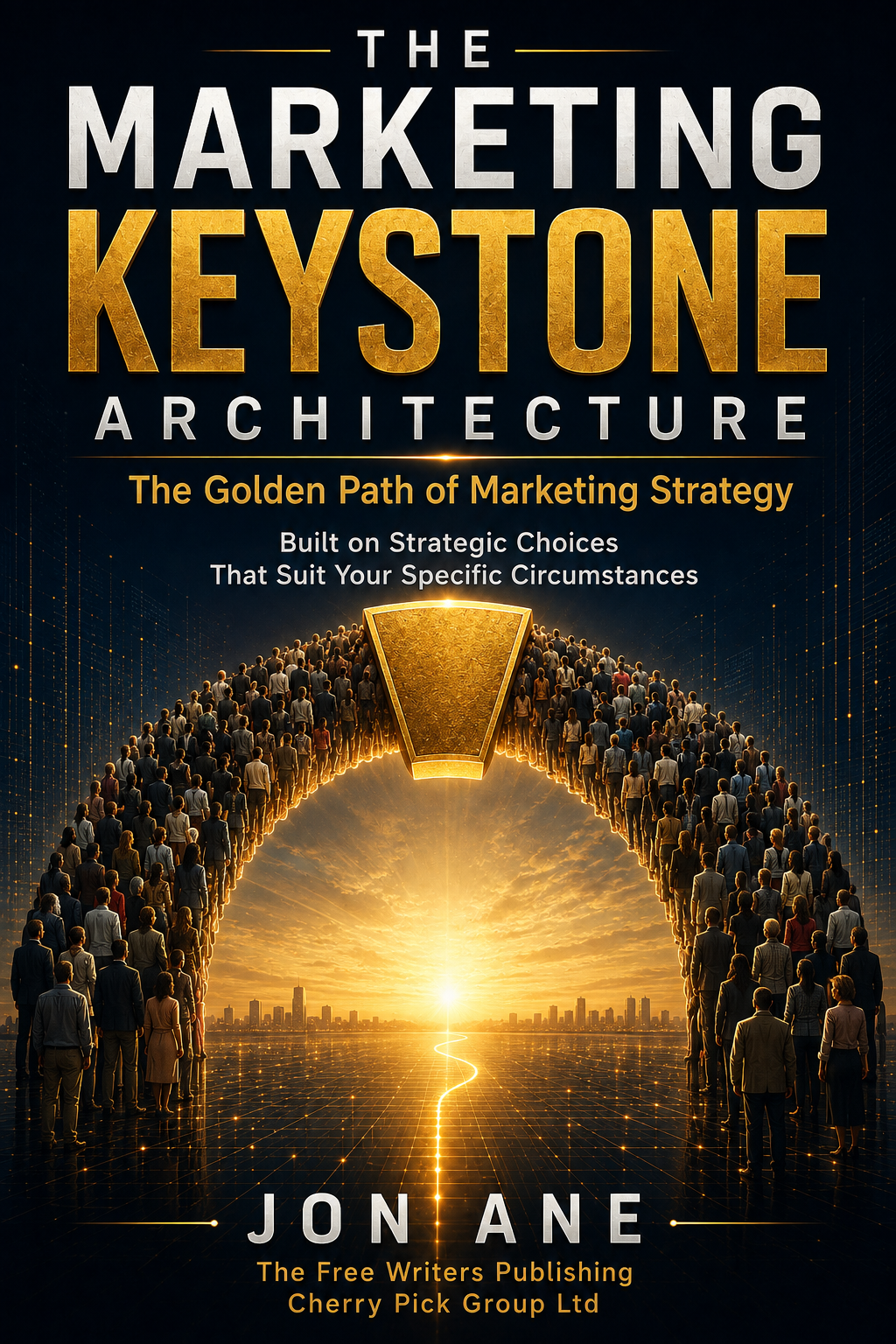
THE MARKETING KEYSTONE ARCHITECTURE: The Golden Path of Marketing Strategy: Built on Strategic Choices That Suit Your Specific Circumstances – By Jon Ane


Original price was: €37.95.€22.99Current price is: €22.99. ex. VAT
The Keystone Method is a Strategic Decision Architecture that guides managers through interconnected Strategic Selections and Strategic Paths, ultimately weaving them into a Golden Path of Strategy.
THE MARKETING KEYSTONE ARCHITECTURE applies this architecture specifically to Marketing through a stand-alone Marketing Keystone comprising 19 Strategic Critical Dimensions and 185 Strategic Paths.
The Marketing Keystone Architecture
The Golden Path of Marketing Strategy: Built on Strategic Choices That Suit Your Specific Circumstances
By Jon Ane
Marketing Strategy is not simply about what you do. It is about what you choose — and how your choices connect.
The Keystone Method is a Strategic Decision Architecture that guides managers through interconnected Strategic Selections and Strategic Paths, ultimately weaving them into a Golden Path of Strategy.
THE MARKETING KEYSTONE ARCHITECTURE applies this architecture specifically to Marketing through a stand-alone Marketing Keystone comprising 19 Strategic Critical Dimensions and 185 Strategic Paths.
At its heart is the G-POST — the instrument that takes the marketer through the architecture, stage by stage. A choice made at one stage can influence the strategic territory available at the next, creating a connected chain of decisions rather than a collection of isolated ideas.
The book also brings the paths to life through real-life business examples, drawn largely from client experience, with names changed where appropriate for confidentiality.
What makes THE MARKETING KEYSTONE ARCHITECTURE different?
- A Strategic Choice Architecture — not simply another collection of marketing models or frameworks.
- Keystone Method + G-POST — the Method provides the architecture; G-POST is the instrument that takes the marketer through it.
- 19 Marketing Strategic Critical Dimensions — strategic decision points brought together within one integrated architecture.
- 185 Strategic Paths — a broad field of alternatives rather than one prescribed route.
- Sequential choices — each Strategic Selection can influence the strategic territory available at subsequent stages.
- Choices become connected — the objective is not to collect attractive options, but to weave compatible choices into one Golden Path of Strategy.
- Strategic D.N.A. — selected paths are expected to share common strategic traits and reinforce one another.
- Core, Core-Mantle and Mantle Product Markets — significant Product Markets are considered together rather than as isolated businesses.
- Resource consequences are explicit — putting more resources behind one Product Market or Strategic Path means considering what becomes available elsewhere.
- Product-Market Life Cycle is built into the selections — different stages can call for different strategic choices.
- Stand-alone Marketing Strategy — the Marketing G-POST can be used even when corporate Strategy provides only broad direction.
- Strategy before tactics — tactics are treated as the servant of the chosen Strategy, not as substitutes for it.
- A panoramic view of strategic alternatives — the marketer can see the strategic landscape before committing to a direction.
- A Golden Path rather than a pile of decisions — the end result is an interconnected strategic route tailored to the organisation’s circumstances.
- A living architecture — the method is open to additional Strategic Paths and future development rather than claiming to be the final word on Strategy.
- Real-life strategic examples throughout — most Strategic Paths are illustrated with practical examples drawn from real client situations, showing how the choices can work in the real business world.
- Confidentiality-conscious cases — where necessary, client names and identifying details have been changed while preserving the strategic substance of the examples.
- Theory connected to practice — the reader is not simply presented with a Strategic Path, but can see how such a choice has appeared in an actual business situation.
See the choices. Understand the connections. Choose your Golden Path.
For your information:
Language: 
ISBN: 978-1-7397183-9-8
Format: E-Book
Pages: 360
Publisher:  Jon Ane Cherry-Pick Group Limited- Free Writers publishing division.
For your information, we print the hard copy book in bulk to some amount. However, If you have ordered and the product isn’t available in stock, it would be considered a pre-order and that one would come with a giveaway.
 Get an invoice: Like many before you did – get an invoice and ask your company to refund you for “Employee education expenses”.
Related products

CHILDREN'S BOOKS
Grandpa Bird A Journey to the Sky: How to Cope with Grief after Losing a Loved One – By Jon Ane