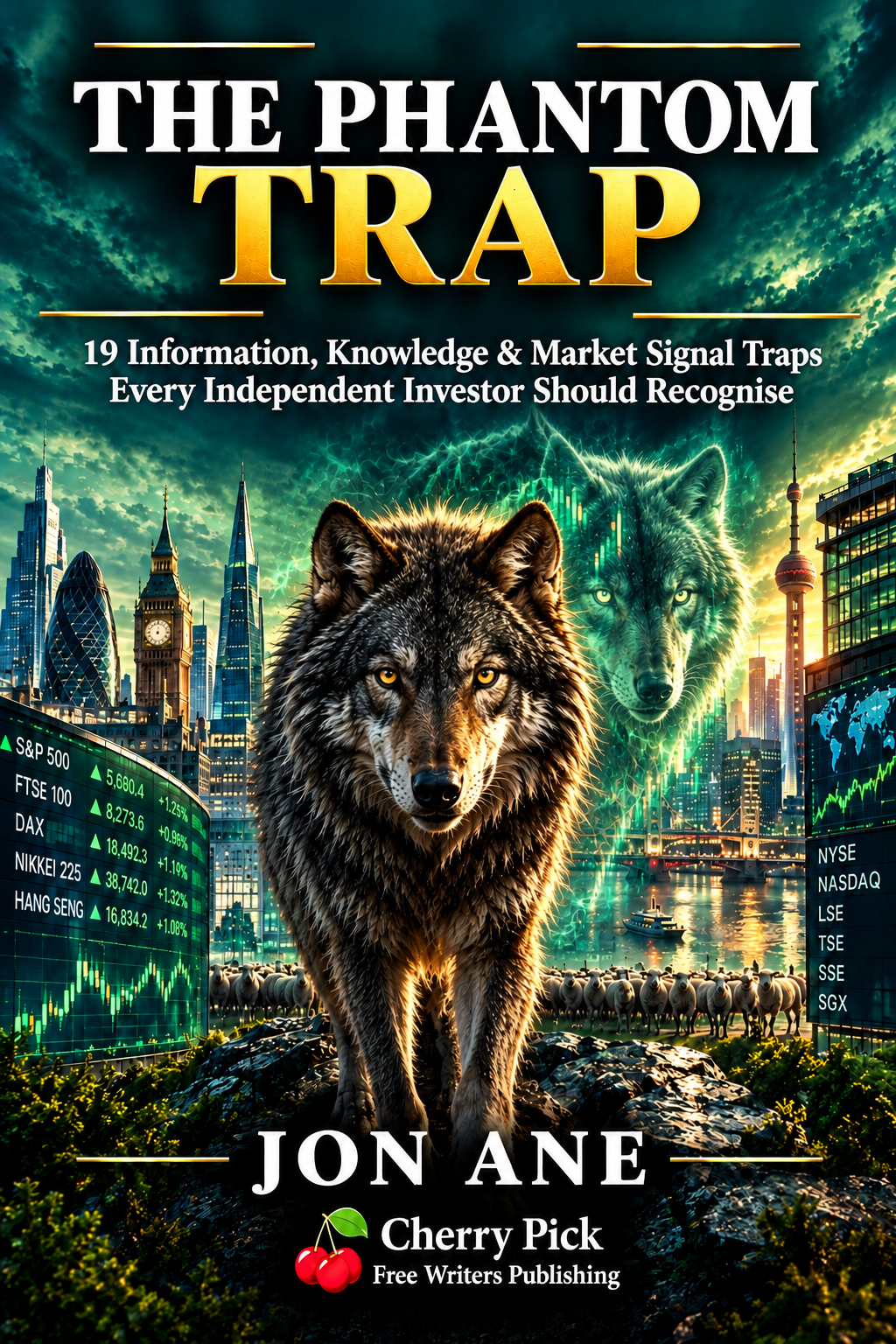
THE PHANTOM TRAP
19 Information, Knowledge & Market Signal Traps Every Independent Investor Should Recognise
By Jon Ane
How much of the information you have is actually helping you invest?
Today’s investor has access to more information than any generation before.
Company reports.
Analyst recommendations.
Economic forecasts.
Breaking news.
Charts.
Social media.
Market commentary.
Trading volumes.
Price movements.
Rumours.
Opinions.
The information never stops.
But here is the problem:
More information does not necessarily make you a better investor.
In fact, sometimes the opposite happens.
The more information you collect, the more confident you become that you understand what is happening.
And that confidence can be dangerously misleading.
You can read an entire annual report and still miss the one fact that matters.
You can follow highly respected analysts and still misunderstand the investment.
You can discover information that is completely accurate—and still draw the wrong conclusion from it.
You can see a dramatic movement in a share price and assume you know why it happened.
And you can surround yourself with information that confirms what you already believe, while quietly ignoring everything that challenges it.
This is the trap.
Information is not understanding.
The Investor’s Trap — Step Two takes you inside 19 information, knowledge and market-signal traps that can distort investment decisions.
This is not a book about finding more information.
It is about learning how to think about the information you already have.
The book introduces three ways of looking at the investment world:
The Sheep sees the information and follows it.
The Wolf understands how information can influence the behaviour of the flock.
The Sheepdog stops and asks:
“What does this information actually tell me?”
That simple question can change the way you read the market.
A company reports record revenue.
Is that automatically good news for shareholders?
A share price rises sharply.
Does that prove the company has become more valuable?
Trading volume suddenly increases.
Why?
An analyst changes a recommendation.
What has actually changed?
A company announces excellent results.
Yet the share price falls.
Another company reports disappointing results.
Yet its share price rises.
Why?
Because markets do not simply react to whether information is good or bad.
They react to expectations.
What happened matters.
But what the market expected to happen can matter even more.
That distinction is one of the central ideas in Step Two.
You will explore the difference between:
Information and knowledge.
Knowledge and understanding.
Facts and opinions.
Signals and explanations.
News and expectations.
Price movements and their possible causes.
And perhaps most importantly:
Evidence and interpretation.
Because seeing something is not the same as understanding it.
A rising share price is a fact.
But the reason for the rise is an interpretation.
A piece of news may be completely true.
But truth alone does not make it relevant.
A market signal may be important.
But a signal is not an explanation.
And information supporting your investment thesis may feel reassuring.
But what happens when you deliberately search for evidence that proves you wrong?
That is where the Sheep Test™ becomes a practical tool.
Instead of asking only:
“Is this information true?”
you learn to ask:
“Is it relevant?”
“What does it actually prove?”
“What does it not prove?”
“What was already expected?”
“What could I be missing?”
These questions can protect an independent investor from one of the most subtle dangers in investing:
believing that understanding has been achieved simply because information has been collected.
Step One of The Investor’s Trap focused on you—your emotions, behaviour, biases and psychological traps.
Step Two moves to what influences you—the information, signals, interpretations and expectations that shape your investment decisions.
Because even if you control your emotions, you can still make a poor investment decision if you misunderstand the information behind it.
The modern investor does not have an information shortage.
The challenge is knowing what deserves attention, what deserves scepticism, and what deserves further investigation.
The market will give you signals.
The question is whether you will blindly follow them—or learn to understand them.
Don’t just find information.
Learn to understand what it really means.